
17 Aug 2026
Investment Property: DMG Group's Kostava 49 Project
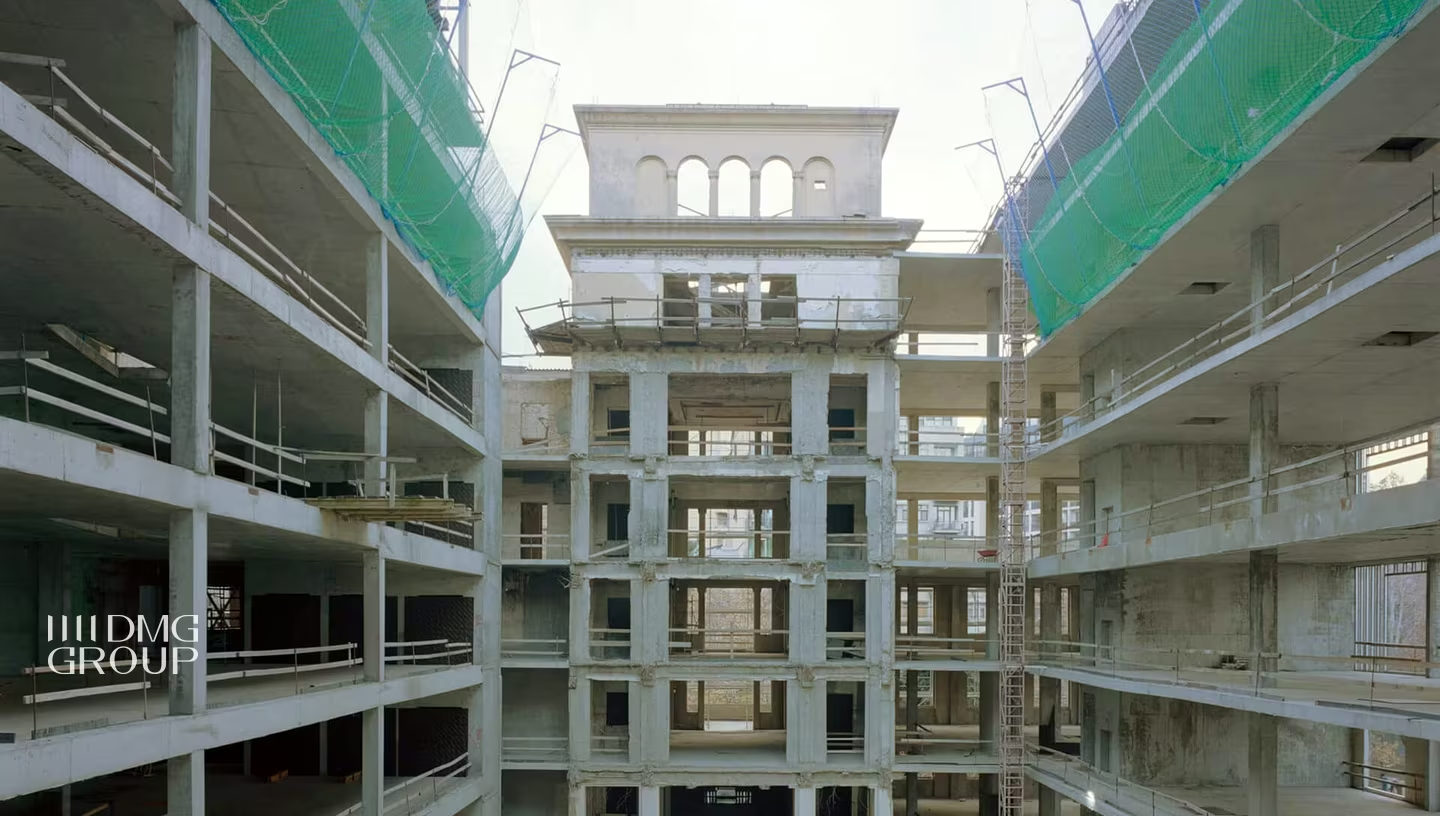
Many historic buildings in Tbilisi today have lost their original function over the years. Some have fallen into ruin, while others have been given a new lease on life through timely investment. Notable examples include Fabrika, Stamba, and the Institute of History and Ethnography.
The primary business objective of projects like these is to create sustainable investment property. This term refers to a property acquired by its owner to generate stable income or for long-term appreciation in value.
DMG Group's real estate development arm, Immobiliare, has joined the ranks of companies that restore and repurpose historic buildings. The company made its first major real estate investment in the historic Ministry of Agriculture building at 49 Kostava Street.
What is Investment Property?
People generally acquire real estate for two main reasons. The first and most important is as a place to live, while the second is as an investment. The primary purpose of an investment property is to generate income. For the average person, this typically involves renting out the property or benefiting from its appreciation in value over time. An investment company, on the other hand, usually takes a more complex approach to real estate investment.
When assessing the potential return on an investment property, one must consider the building's current condition, its purpose, location, market demand, and liquidity. Companies making larger-scale investments, however, need to account for additional factors: construction regulations, zoning laws, long-term market fluctuations, the global economic situation, the monetary policy of the National Bank, etc.
Acquiring real estate is just the first step in the investment cycle. Generating long-term income requires stable demand, which in turn depends on proper asset management. Vacancy periods, maintenance issues, and high operating costs can significantly reduce profit margins. In some cases, the asset may even operate at a loss. Often, a professional asset management service is a key factor in maintaining and increasing a property's value.
How does a historic property differ from a standard investment property?
Historic buildings represent an entirely distinct category in the real estate market. When working with them, developers must operate within a very strict framework.
To put it simply, a building with a unique facade constructed in 1936 doesn't belong solely to its owner; it is, in part, considered public property. Consequently, the owner is not permitted to demolish or alter it at will. A historically protected facade naturally restricts certain avenues for increasing profit margins. For instance, the potential supply is already strictly defined: it is not possible to add extra floors or construct an adjacent building that would compromise the property's historic character.
On the other hand, historic buildings also offer significant advantages. For one thing, such properties are often located in well-established neighborhoods. The surrounding infrastructure is already in place, and there has been stable demand for years.
DMG Group's Investment in the Ministry of Agriculture Building
DMG Group's real estate development arm, Immobiliare, is undertaking its first large-scale project at 49 Kostava Street. The historic building was designed by architect Mikheil Neprintsev. It originally served as the administrative center for the tea industry before later becoming home to the Ministry of Agriculture. Today, the building is officially designated as a cultural heritage monument.
The renowned firm of legendary Spanish architect Ricardo Bofill developed the renovation concept. Before any work began, the team spent two months studying the architecture of Tbilisi, including its Soviet-era heritage. As a result, the building's historic facade will remain untouched, while the interior spaces have been completely redesigned to meet modern, premium standards. Detailed specifications for the project are available at dmg-group.ge.
Upon completion of the renovation, the building will house 81 residential units, commercial spaces, and a restaurant. The complex will also feature a fitness zone and underground parking. The total investment in the project amounts to 200 million GEL, and construction is scheduled for completion by the end of 2027.
In the case of historic buildings, premium infrastructure is a natural way to offset the scarcity caused by limited supply. Since developers are constrained by the existing facade and can only offer a small number of units for sale, they need to maximize the price. High-quality services and a superior standard of living naturally increase demand and, consequently, the project's value. Capital management must also account for the fact that restoring a historic property requires more time and financial resources than new construction.
In premium-class properties, amenities are not merely decorative. Concierge services, wellness spaces, and reliable technical support have a direct impact on a property's occupancy and rental rates.
How Profitable Is an Investment in a Historic Building? Financial Model and Profitability Assessment
A crucial stage in the financial analysis of any project is calculating the discount for an investment property, which serves to determine the present value of future income. This process generally involves three steps: forecasting cash flows, selecting a discount rate, and the mathematical calculation.
To illustrate with a simple example: if an income of 100,000 GEL is expected from a property in five years and the discount rate is 10 percent, the present value of this amount is approximately 62,000 GEL. The most crucial step in this calculation is selecting the correct discount rate, which combines the base rate and risk. Consequently, the more reliable and predictable the expected income, the lower the risk premium, and the more valuable the investment property is today.
This financial model clearly illustrates why a historic property has a distinct investment profile. While its limited supply on the market may constrain the scale of cash flows, it also makes projecting stable income easier - with optimal management of the space, revenue becomes more predictable.
Investment fund DMG Group plans to apply the same approach to its future projects. Development plans include the historic Silk Factory, along with the large-scale rehabilitation of the Tobacco Factory and Laguna Vere. The total investment volume for the planned works exceeds 1 billion GEL.
For the first stage of its real estate development, the company is concentrating primarily on the capital, though it is also considering expansion into other regions within a five-year timeframe. As company founder Kakhi Zhordania notes, the group's capital is generated entirely from international business activities, ensuring the stability of its current projects.
